
It’s a Saturday morning in Swakopmund, and while some people prepare to go to work, Pius accompanies his mother to sell thrifted items. He has always been a curious child, and his mother’s business choice was no different to his curiosities.
In most of the towns in Namibia, we have what we call omiyalo. Translated from Oshiwambo, the word refers to ‘things that are laid out’. This is the way thrifted items were sold back in the day. Currently, because technology has made accessibility easier, omiyalo have gone virtual.
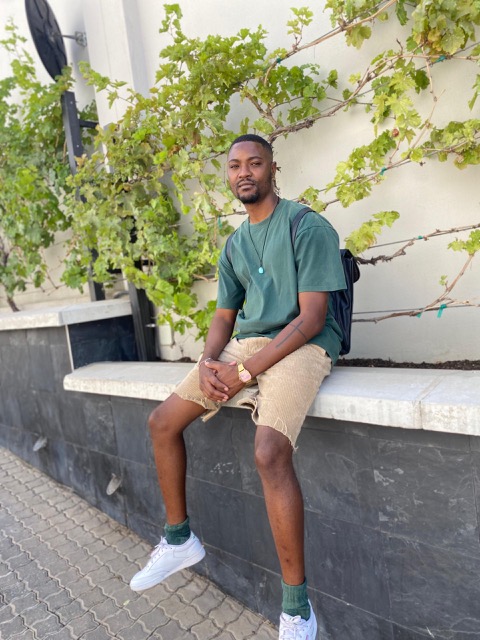
Twenty-nine-year-old Pius ‘Stitch’ Djuulume founded his thrifting business, Paramount Stitch, in 2019. Born in Rehoboth and raised in Windhoek, Pius grew up in the coastal town of Swakopmund. We sat down with him to talk about his childhood, his inspiration for thrifting, and what his everyday outfit looks like.
Pius says he always wanted to become a pilot. However, because of his circumstances, his dream did not materialise, so he enrolled for a Bachelor of Land Management at the Namibia University of Science and Technology right after high school.
Early 2019, Stitch dropped out of his Land Management programme, and with no means of survival, he started thrifting and selling the second-hand clothes he got. When he started, he says he didn’t have a name; however, somewhere, he got the name Paramount Stitch for reasons known only to him.
‘I started with five jackets, and because I grew up helping my mother sell these clothes, it was easier for me to know and pick out the fashionable items for people.’ By early 2021, Paramount Stitch was a household name, and the brand only grew bigger.
Why did you start this brand?
Describing his journey as worth pursuing, he says thrifting has allowed him to dress individuals with ‘limited edition’ items.
Dubbing himself the ‘Oupa Indongo’ of the thrifting industry, he says his mother inspired him to dress people. He says his advantage over everyone else is knowing which items would work for people and which ones to bring back into fashion.
Arguing that one would find him thrifting or outsourcing mostly streetwear clothes, he also focuses on Jackets like windbreakers and hoodies. Being able to dress people brings him the most joy. Being in the creative industry has also played an important role in why he continues thrifting and growing his brand. For some time now, he has had the privilege of dressing artists like Leathermein, Dee’A and Franklin. His items have also been featured in one of the local poets’, Damn_Etu, video.
Describe your personal style.
I am a guy who loves fashion, and it doesn’t matter if it’s modern or vintage. I wear anything if it is comfortable and unique. My first love is streetwear, though. This is because streetwear is easy to style. It can literally be a combination of a simple shirt, floppy (if it is an ordinary day to run errands), and sneakers. Because this has become my personality and dress code, I often get a lot of compliments. I mean, who doesn’t want compliments? I grew up in the township, and this, to me, is sort of my identity. It is very flexible, and it boosts one’s confidence. And, if not always, this confidence is because, with thrifting, you wouldn’t find anyone else dressed exactly like you. You would always be different from the rest because thrifting is unique like that.
What do YOU thrift for clients and for YOURSELF? What’s your best-thrifted item so far?
When it comes to thrifting, one must be strategic and consider many factors. It is important to know what is in fashion at that time. Sometimes, you will thrift jeans, but cargo pants are in fashion at that point. Chances are that the items might sell differently than you would anticipate. As such, strategic market and audience research is important. The one thing that sells better than everything else is the hoodies and jackets. That is what Paramount Stitch is known for. So, when I thrift, I must ensure that jackets and hoodies are an addition to whatever is in fashion.
Because he is a man who likes taking risks, he often also sells Casio watches as an addition. “A lot of things are changing as the years go by; people do not get clothes or other things at a cheap price as they used to. Today, if you want a proper jacket in a store, you will find it ranging from N$800 to N$1500. With thrifting, one can get a proper, quality, and unique jacket that is even better than the one you buy from a shop today. In other words, I bring good quality clothes closer to people at an affordable price, if not relatively cheap.
What is the impact of thrifting?
The world is changing, and thrifting impacts the economy, environment and other things. Thrifting helps with waste management and boosting local businesses. Because thrifting started back in the day, it is also a means of income for many families. Back then, and in most parts of the country, women sell thrifted items at pension sessions (popendjela). Currently, Paramount Stitch is a sole proprietor. However, hopefully, by God’s Grace, I will be able to grow as a person and as a businessman, so I can create jobs for my community and one day give back to them.
Do you think there’s an opportunity for thrifting to grow in Namibia?
Namibia has a small population, so the only way one can really grow as a businessman in thrifting is by expanding through social media and other ways of selling items. There is an opportunity for thrifting in Namibia, but one must work really hard to really make an impact and get to be known all over the country. Thrifting is beautiful, and I hope we get assistance in expanding one day.
Marc Anthony said that if you do what you love, you’ll never work a day in your life. This is definitely testament of the work Pius does.
If you would like to collaborate or invest, you can find Pius’ work on social media.
Instagram: Paramount_Stitch or visit their store at 10005, Legion, Windhoek.
